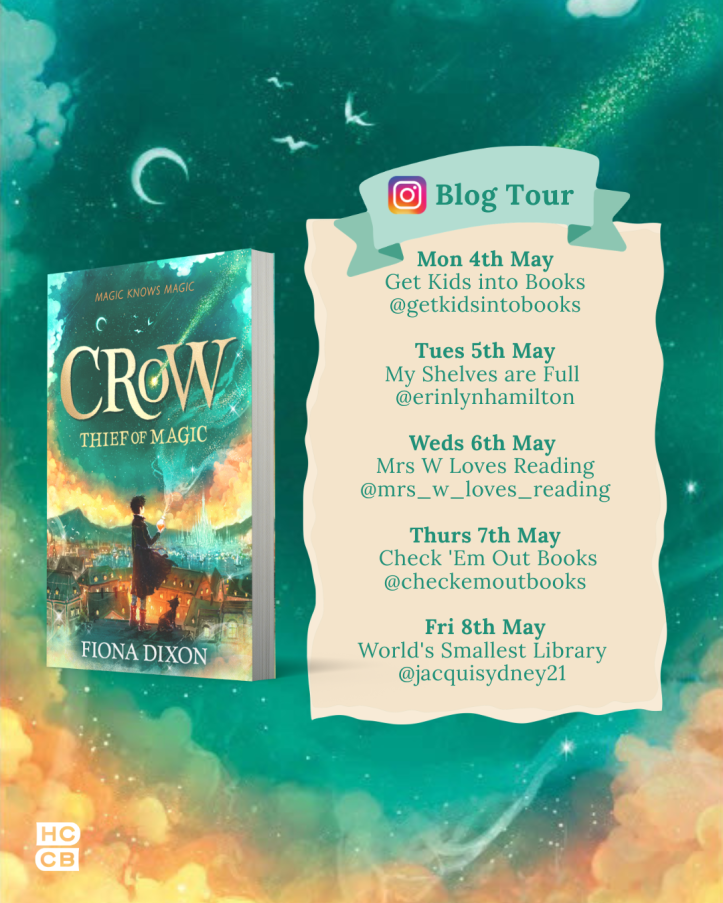

I’m delighted to welcome author Fiona Dixon to my blog today. Her debut novel, Crow: Thief of Magic, is such an incredible book! Her grimy underworld of street gangs and thieves reminded me of Victorian London and Oliver Twist. Fiona then weaves in dream magic and sorcery for a truly captivating read. The world-building is a delight and I can’t tell you how long I spent poring over the gloriously detailed map at the front of the book!
Today, in her guest post, Fiona shares how she first came up with the idea for dream magic.
The Origins of Dream Magic
I’ve always had vivid dreams that I remember long after waking – and the initial idea for the story that would become Crow: Thief of Magic, quite fittingly, came from a dream. I had an image of a ragged, dark haired boy in the snow, and a huge library-like room. But instead of books, all the shelves were filled with bottles of magical dreams. That got me thinking: how might someone make dreams, and why?
The seed of a story was sown, and the boy from my dream became Crow, a 12-year-old thief and errand boy for an organisation known as the Reavers, who run the city’s underworld. More than anything, Crow longs to escape from the underworld, and to make a better life for himself.
A chance encounter with a mysterious sorcerer, Viktor, leads to an offer of an apprenticeship, and an opportunity for Crow to learn the ancient art of dream magic.
Dreamcatchers have a rare type of magic – the power to create dreams infused with magic that could change someone’s life, for example, to help them overcome grief, inspire confidence or self-belief, or enhance their creativity. There are two main types: minor dreams, which have a limited, temporary effect, and can be enjoyed by anyone; and major dreams, which as the name suggests are much more powerful, and have the potential to affect not just one person’s life, but create a ripple effect.
Making dreams, as Viktor explains to Crow, is a complicated process: part magic, part alchemy. Each dream has an entry in The Book of Dreams, a Dreamcatcher’s grimoire, which lists the ingredients and the instructions for how to make it. The practical part of the dream-making process was actually inspired by chemistry lessons at secondary school (thanks, Mr Latham!), including the long, wooden benches, bunsen burners, and strange-looking interconnected glass tubes readers will discover in the Dreamcatcher’s laboratory.
However, the ingredients used in the dream-making process are a little more exotic than what you’d typically find in a school chemistry lab (although some of them are just as nose-wrinklingly stinky once they’re mixed into a potion!). There are jars full of everything from ground narwhal horn to feathers, herbs and gemstones.
Once a dream has been made, it appears like a liquid – until you touch the bottle, then it transforms into a smoke-like substance. They range in colour from jade green for dreams of exploration, palest pink for dreams of love and joy, and azure blue for dreams of flying. For me, writing about the dreams was a little bit of wish fulfilllment, as I’ve always wondered what it would be like to fly! If you could pick any dream, what would you choose?

